

Thinking about a master’s in business analytics and applied AI? The most important thing to know is this: AI is expanding the analyst’s role and creating new opportunities across every industry. The right program builds judgment, leadership, and applied AI fluency rather than tool skills alone. Here’s what to consider:
- AI has taken analytics further than ever. The field now runs from descriptive methods through agentic AI to AI-native leadership.
- The most valuable capabilities are human ones. Problem framing, critical evaluation, business communication, and implementation matter more than tool skills alone.
- No programming background is required. Students build working fluency in Python, SQL, machine learning, and cloud-based AI platforms.
- Quantic’s Master of Science in Business Analytics and Applied AI is accredited, fully online, and takes 13 months, culminating in a nine-month Capstone Project that produces portfolio-ready proof of work.
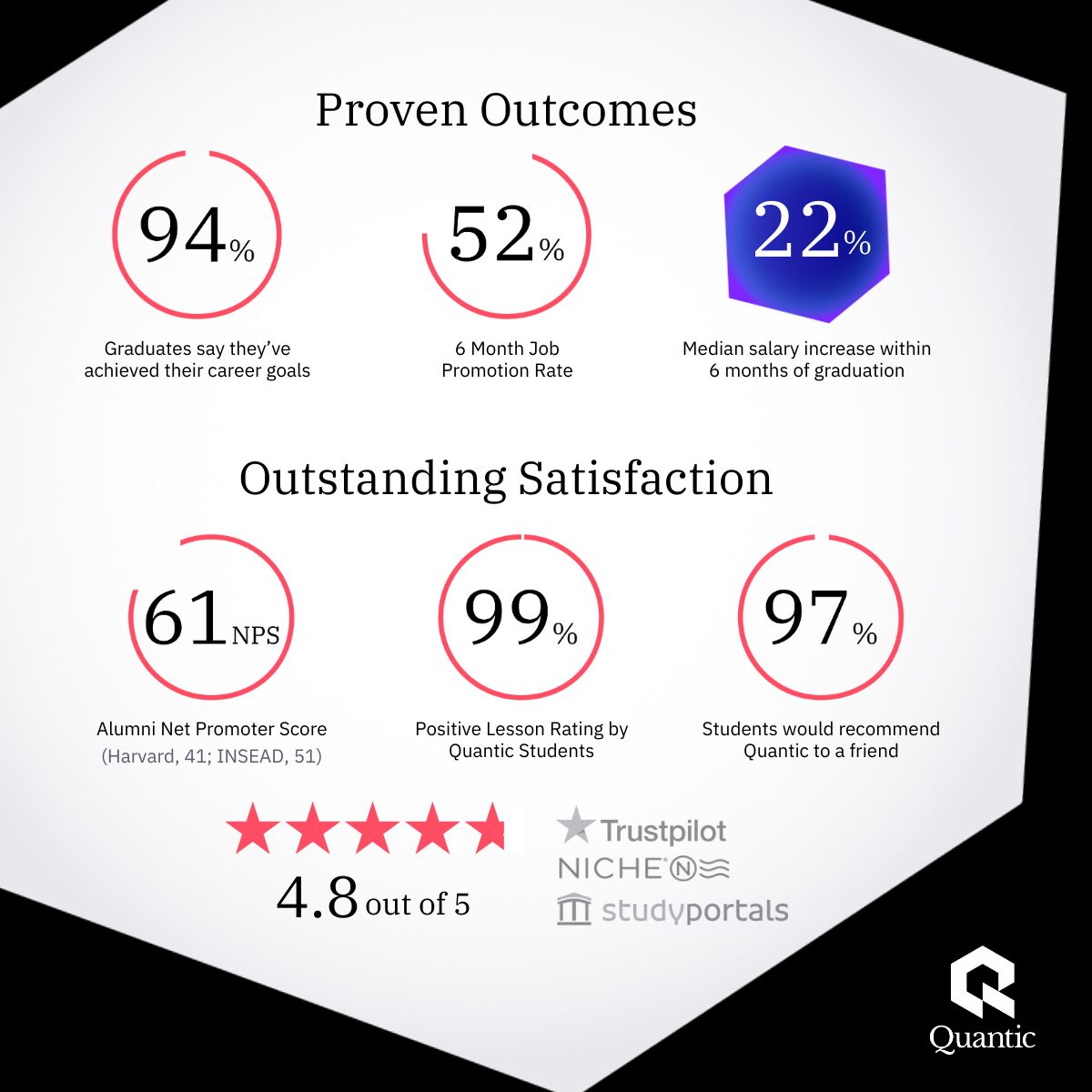
- Outcomes back it up. Across Quantic programs, 52% of students earn a promotion within six months of graduation, and 94% say they’ve achieved their career goals.
By Dr. Darshan Desai, Academic Program Director, Business Analytics, Quantic School of Business and Technology | Last updated: 27 July 2026
Artificial intelligence is no longer the biggest challenge for organizations. Applying it well is.
As AI becomes part of everyday business, the harder work is identifying the right opportunities, evaluating evidence critically, and translating analytics and AI into better decisions, stronger products, smarter operations, and more effective strategy.
Organizations increasingly need people who can identify where AI creates meaningful value, ask better questions, connect technical and business teams, and turn insight into measurable results. Organizations rarely struggle because they lack AI. More often, they have not connected it to the right problems, evidence, and business context. That belief shaped Quantic’s Master of Science in Business Analytics and Applied AI.
“AI does not create value by itself. People create value by applying it to the right problems with sound judgment and a deep understanding of business. That is why we designed this program to develop AI-native analytics leaders who can turn analytics, applied AI, and business judgment into measurable organizational impact.”
Dr. Darshan Desai, Academic Program Director, Business Analytics
Whether you want to broaden your impact in your current role, transition into an analytics- or AI-enabled career, or lead AI initiatives within your organization, this guide answers the questions prospective students ask most often.
The Future of Analytics and AI
Access to AI is expanding quickly, but access alone does not create advantage. Organizations need people who can identify valuable problems, determine where AI belongs, integrate it into products and workflows, and measure whether it improves outcomes.
That work requires more than technical expertise. It calls for problem framing, critical evaluation, cross-functional communication, and business judgment. Professionals who connect analytics, AI, and strategy can help organizations improve decisions, redesign workflows, and move from experimentation to meaningful results.
As AI becomes embedded across industries, this combination of analytical thinking, technical fluency, and strategic judgment will become increasingly valuable.
*****
An AI-native analytics leader treats analytics and AI as part of everyday problem-solving, not as isolated tools.
These professionals identify high-value opportunities, ask better questions, evaluate data and AI-generated outputs critically, communicate with technical and business stakeholders, and guide implementation responsibly. They also understand that not every problem requires AI. Good judgment includes knowing when a traditional analytical approach is more appropriate and where human oversight remains essential.
As AI becomes a normal part of work, organizations will rely on people who can bridge technology and business while keeping decisions grounded in evidence, context, and accountability.
*****
✅ Descriptive analytics — What happened?
✅ Diagnostic analytics — Why did it happen?
✅Predictive analytics — What is likely to happen?
✅Prescriptive analytics — What should we do?
✅Applied AI — How can AI help solve this problem?
✅Agentic AI — How can intelligent systems work with people to execute more complex workflows?
✅AI-native leadership — How do we redesign decisions, products, operations, and strategy to create value responsibly?
Descriptive, diagnostic, predictive, and prescriptive methods remain essential, while applied and agentic AI can accelerate exploration, automate routine work, and support increasingly complex workflows.
This evolution is changing the analyst’s role. Success is no longer defined only by building dashboards or models. It increasingly depends on identifying valuable opportunities, designing effective workflows, evaluating AI-generated outputs, and ensuring that intelligent systems produce reliable and responsible results.
The future of analytics is about equipping people to work with increasingly capable systems to solve more meaningful problems.
*****
Four capabilities stand out as AI becomes embedded across products, operations, and decision-making:
1️⃣ Problem framing. Before selecting a model or tool, professionals must identify the business problem, the decision that needs to improve, and how success will be measured. A sophisticated solution to the wrong problem rarely creates value.
2️⃣ Critical evaluation. AI-generated outputs should inform decisions, not replace judgment. Professionals need to assess data quality, recognize bias, question assumptions, understand uncertainty, and determine when human oversight is essential.
3️⃣ Business communication. Analysis has little impact if decision-makers cannot understand or trust it. Professionals must explain insights and trade-offs clearly and build alignment across technical and business teams.
4️⃣ Implementation and continuous learning. Value creation does not end when a model is built. Organizations need people who can redesign workflows, measure outcomes, learn from results, and improve AI-enabled processes as needs evolve.
Together, these capabilities distinguish people who simply use AI tools from those who lead AI-enabled transformation.
*****
Quite a lot — because this degree builds capabilities, not a single job title. Graduates of Quantic’s Master of Science in Business Analytics and Applied AI are prepared to apply analytics and AI wherever organizations need better decisions, smarter operations, stronger products, and more effective strategy.
Depending on their experience and goals, graduates may pursue roles such as:
✅ Analytics Manager
✅ Business Intelligence Leader
✅ AI Product Manager or Product Strategist
✅ Product or Operations Analytics Lead
✅ Data or AI Strategy Professional
✅ AI Enablement Lead
✅ Decision Intelligence Professional
✅ Digital Transformation Professional
Across these roles, graduates can identify high-value opportunities, evaluate AI-supported solutions, align technical and business teams, and guide initiatives toward measurable results. For some, the degree supports a career transition. For others, it expands their influence within an existing role or organization.
*****
Inside the Program
Quantic’s Master of Science in Business Analytics and Applied AI is an accredited, fully online, 13-month graduate degree focused on applying analytics and AI across products, operations, and strategy.
The program integrates advanced analytics, applied AI, business strategy, communication, and responsible implementation. Students learn how these areas work together to solve business problems, improve decisions, and create organizational value.
Learning takes place through Quantic’s interactive, mobile-first platform, with active participation, real-world scenarios, and practical application. Students develop the technical fluency to work with modern tools and the business judgment to lead AI-enabled transformation responsibly.
*****
The program is designed for professionals who want to go from functional specialists to AI-native analytics leaders. It is especially well suited for:
✅ Business and functional professionals who want to use analytics and AI to improve products, operations, strategy, marketing, finance, healthcare, consulting, or other areas.
✅ Career accelerators, career changers, and recent graduates who want practical capabilities for rapidly evolving analytics- and AI-enabled roles.
✅ Technical and data professionals who want to complement their expertise with stronger business strategy, communication, and leadership skills.
Students come from diverse academic and professional backgrounds, united by a desire to solve meaningful problems and create greater impact through analytics and AI.
*****
No. Prior programming or software engineering experience is not required.
Students develop practical fluency with Python, SQL, data visualization, machine learning, business intelligence, cloud-based AI platforms, Git, and GitHub while applying these tools to organizational challenges.
The goal is not to turn every student into a software engineer or machine learning researcher. It is to prepare professionals who can work effectively with technical teams, evaluate AI-enabled solutions, make informed decisions, and lead responsible conversations about how technology should be applied.
*****
Students do not just learn analytics and applied AI — they apply them throughout the program to solve increasingly complex business problems.
The curriculum covers statistics, business analytics, applied AI, machine learning, data visualization, communication, and modern analytical frameworks. Applied projects build experience in problem framing, evidence evaluation, responsible AI, and business decision-making.
The program culminates in a nine-month Capstone project. Student teams identify a real business problem, analyze relevant data, evaluate AI-enabled approaches, develop a proof-of-work solution or prototype, and present recommendations grounded in evidence and business value.
Graduates leave with more than a degree. They leave with practical work that demonstrates their ability to apply analytics and AI to meaningful organizational challenges.
*****
Yes — and the strongest evidence is outcomes. What distinguishes Quantic is not one feature, but how the experience comes together: an accredited 13-month degree, interactive mobile-first learning, an integrated curriculum spanning analytics, AI, strategy, and communication, and a nine-month Capstone Project that produces portfolio-ready proof of work.
Students use these capabilities together to frame business problems, evaluate data and AI outputs, communicate across functions, and build solutions connected to measurable outcomes.
Across Quantic programs, Quantic reports that:
✅ 52% of students earn a promotion within six months of graduation.
✅ 94% say they have achieved their career goals.
✅ 86% say their program directly helped them get there.
For students seeking flexibility without sacrificing rigor, application, or career relevance, that combination is a meaningful differentiator.
*****
Final Thoughts
So — is a master’s in business analytics worth it in the age of AI? For professionals who build judgment alongside technical fluency, the evidence points to yes.
Artificial intelligence is changing how organizations work, compete, and innovate. But technology alone does not create transformation. People do.
The professionals who create the greatest impact will understand where AI adds value, how to evaluate it responsibly, and how to connect it to better business decisions.
That is the vision behind Quantic’s Master of Science in Business Analytics and Applied AI. The program is designed to help professionals go from functional specialists to AI-native analytics leaders who can apply analytics and AI across products, operations, and strategy.
Analytics provides the evidence. AI expands the possibilities. Business judgment turns both into impact.
Whether you want to advance your career, broaden your impact within your organization, or prepare for AI-enabled leadership, the program provides the knowledge, experience, and proof of work to help you move forward.
The future belongs to professionals who know not just how to use AI, but where it creates value.
Ready to Start?
If this guide answered your biggest questions, here’s how to take the next step:
Apply to the program. Begin your application to the Master of Science in Business Analytics and Applied AI.
Talk it through with an advisor. Schedule a free 1:1 video chat with an Admissions Advisor to discuss fit, curriculum, and your career goals.
Have a quick question? Email the admissions team at [email protected] — they’re happy to help.
More on the Quantic Blog:
- The Best Online EMBA: Highly-Rated Programs FAQ 2026
- Quantic: The Highly Selective, Mobile-First Business School
- An Online MBA with Real-World Connectivity? Yes.
- The Best Online MBA Recognized By Top Employers: Quantic MBA
- Quantic Review: Top Companies Pay for the Best Online EMBA
- What is The Best Affordable Online EMBA: Top Programs 2025
- Qantic School Review: Drawbacks & ROI of Online MBA Programs
- What is The Best Online EMBA: Highly-Rated Programs 2025
- Is An Online Executive MBA Worth It: Challenges vs ROI
- MBA vs Executive MBA: Which Fits Your Career Growth at 30?
- Affordable MBA: A Flexible, Top-Tier Education That’s AI-Powered
- Is an MBA Worth It in the Age of AI? Facts & Insights 2025
- Quantic MBA Review: Curriculum, Admissions, Pros & Cons
- What is the Best Online MBA Program? Quantic Review Insights
- Quantic School Reviews: What Our Graduates Are Saying
- Quantic Review: Executive MBA vs MBA – What is Right for You
- Quantic Executive MBA Review: Benefits, Features & Outcomes
- Is Quantic’s MBA worth it: Real Student Reviews and Outcomes
- Quantic Reviews: Hearing Directly From Students and Alumni
- MSBA vs MBA – The Difference Explained. Which One is Better?


